
Listening Comprehension: The Skill We Still Don’t Teach
A number of years ago, I came across an article that ran in Harvard Business Review in 1957. It was titled, “Listening to People,” and it made a simple argument: listening comprehension should be taught in schools.
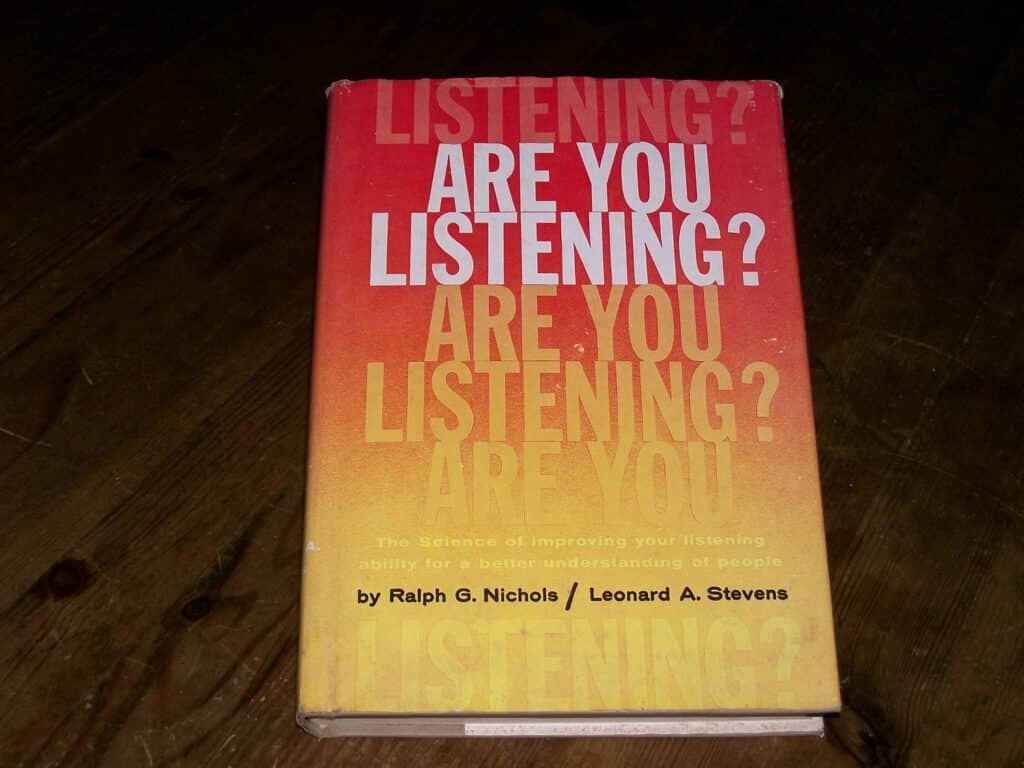
The authors, Ralph G. Nichols and Leonard A. Stevens, adapted it from their book, Are You Listening? Nichols ran the communication program at the University of Minnesota. Their case was that people generally don’t know how to listen, and schools are to blame.
That was nearly 70 years ago. I went back to the article recently, and I’m not frustrated or angry about it. I’m being realistic. Listening comprehension is no better off today, and at work, where people talk all day, that costs us.
What did the 1957 study find?
Students spend years learning to read. Reading comprehension is a skill that is taught. Listening comprehension isn’t, even though we spend far more of our lives listening to people than reading books.
Nichols tested several thousand students and hundreds of businesspeople. After hearing someone speak, listeners remembered about half of what they heard. A couple of months later, they remembered about a quarter of what they heard. I think those numbers were generous then, and I suspect they’re worse now.
Nichols and Stevens made their argument in 1957, and the education system ignored it.
Can listening be taught?
Yes, and the same research proved it. A group of University of Minnesota freshmen took a course dedicated entirely to listening. Their listening skills improved 25 percent, and some groups improved by as much as 40 percent. In an adult class, 60 people nearly doubled their scores after 17 weekly sessions.
Listening is a skill you can measure and improve. We just don’t make time for it.
What is the Elusive 600?
The Elusive 600 is the gap between how fast your brain processes spoken words and how fast people speak. Your brain runs at about 750 words per minute. The average person speaks at about 150. That leaves roughly 600 words of spare mental capacity while someone talks to you. If you don’t know how to leverage the Elusive 600, your mind will take you all over the place while you’re supposedly listening to someone speak.
This is where listening lives. Nichols and Stevens noticed the same gap in 1957, with slightly different numbers: speech around 125 words per minute and thinking speed up to about 800. Effective listening comes down to one question: what do you do with that spare mental capacity?
What are the 10 bad listening habits?
In July 1957, the business magazine Nation’s Business ran a companion piece by Nichols, “Listening Is a 10-Part Skill,” that listed 10 bad listening habits. They’re worth keeping in mind as you reflect on how you listen:
- Calling the subject uninteresting.
- Criticizing the speaker’s delivery.
- Getting overstimulated and preparing your response.
- Listening only for facts.
- Trying to outline or take notes on everything.
- Faking attention.
- Tolerating distractions.
- Avoiding difficult material.
- Reacting to emotional words.
- Wasting the gap between speaking speed and thinking speed.
Number seven is much of what my book NOISE: Living and Leading When Nobody Can Focus is about. Number 10 is the Elusive 600.
Why don’t we teach listening?
I’ve talked about listening on the Just Saying podcast for years, in episodes like Why is listening so hard?, Hey, listen to why it’s so difficult, Asking much better questions, and The things we hear (aren’t always right).
In Episode 108, I introduced present listening: being in the moment and giving the other person the gift of your undivided attention. Yet listening still isn’t widely taught, and I see a few reasons why:
- It isn’t an attractive topic. Teaching people to speak and present feels more interesting. Listening is the other half of communication: what’s heard instead of what’s said. Listening is silent, and unseen.
- Most people think they’re already good listeners. I beg to differ. At The BRIEF Lab, we embed listening exercises into every class we teach, because it’s very easy for people to drift and let their elusive 600 run wild.
- Training over-indexes on talking. We teach people to prepare, say the most important thing first, trim excess information, and own the clarity and brevity equation. I’ll admit The BRIEF Lab is guilty of this, too.
- Listening gets buried in the curriculum. When listening shows up, it’s there but not really there. Most training doesn’t go much further than telling people to pay attention.
The exception I’ve found is Raquel Ark, who runs Listening Alchemy and hosts the Listening Superpower podcast. She built an entire coaching and facilitation practice around listening, and I’ve enjoyed our conversations on her show about quiet, brevity, and the value of listening.
Listen in such a way that people love to talk to you, and talk in such a way that people love to listen to you.
Why does listening matter more in the age of AI?
I’ve been focusing lately on critical human skills, that is, the skills only humans possess. AI can’t listen to someone the way you can. It isn’t a person. You are. Meanwhile, people keep talking, the noise keeps rising, and the easy response is to tune people out.
Nichols and Stevens made their argument in 1957, and the education system ignored it. It matters even more now than it did then.
How many good listeners do you know?
Outside of family and friends, how many people in your professional life would you call really good listeners? I’ve asked many people that question. I never get more than two or three names.
My response is always the same: be one of those people. There may be no more than five in anyone’s life. Be one of the five.
To borrow Raquel’s phrase, listening is a superpower. When someone is genuinely interested, asks better questions, focuses, and sets aside their own interests and feelings to understand what you’re trying to say, even when it’s difficult, they stand in a rare group. I’ve met people like that, and you immediately love talking to them. It’s powerful to be heard and understood that way.
I heard a line I’ll paraphrase: listen in such a way that people love to talk to you, and talk in such a way that people love to listen to you. Because if everyone is talking, no one is listening.
How can The BRIEF Lab help
At The BRIEF Lab, we help teams communicate with clarity and brevity, and listening is half of that equation. We build listening into every session so people learn to use the elusive 600 instead of wasting it. Contact us to learn more.
Joseph McCormack first shared these ideas in the Just Saying podcast Ep. 406: Listening comprehension is still missing in schools