
Don’t Apologize for a Boring Topic. Fix It.
Some topics are naturally interesting. Some aren’t.
You know the difference. A story about innovation, leadership, or a big decision? Easy.
A mandatory process update, technical procedure, compliance module, or onboarding walkthrough? Not so much.
And yet, every professional eventually faces the same challenge: You have to explain something important that nobody is naturally excited to hear.
That doesn’t mean you give up on it. Actually, that’s the first mistake to avoid.
Don’t Quit on the Topic
When people are asked to brief, teach, or train on a dry subject, the temptation is immediate: This is boring. Nobody cares. Let’s just get through it.
That mindset is fatal. If you quit on the topic, your audience will quit on it too.
You do not have to pretend the material is thrilling. You can admit it is technical, narrow, procedural, or tedious. But the minute you surrender to that reality, the session is over before it starts.
Your audience takes cues from you. If you sound bored, they will be bored. If you appear resigned, they will disconnect. If you treat the subject like a burden, they will experience it that way.
The communicator has to breathe life into the material before the audience ever will.
Find the Thread That Interests You
This is where a lot of people get stuck. They assume the whole topic is boring, so there is nothing worth saving. That is rarely true.
Usually, there is something interesting buried inside it:
- A historical detail
- A practical consequence
- A point of pride
- A real-world application
- A risk people underestimate
- A human story behind the process
Find that thread and pull on it.
Years ago, early in my career, I worked in sales for a British telecommunications company. In the beginning, I was terrible at selling. Honestly, I thought I might get fired.
My boss asked me a simple question: What do you find interesting about the company?
I started talking about its history. It had laid the first transatlantic cable. It had roots in the British Empire. It had a legacy that was bigger than “phone service.”
His answer was simple: Tell people that. That changed everything.
When you talk about what genuinely interests you, your energy changes. Your conviction changes. Your audience feels that. What gets transferred is not just information. It is interest. And interest is contagious.
Use a Story as the Trojan Horse
Storytelling is one of the best ways to carry technical, procedural, or tedious information into the mind of the listener.
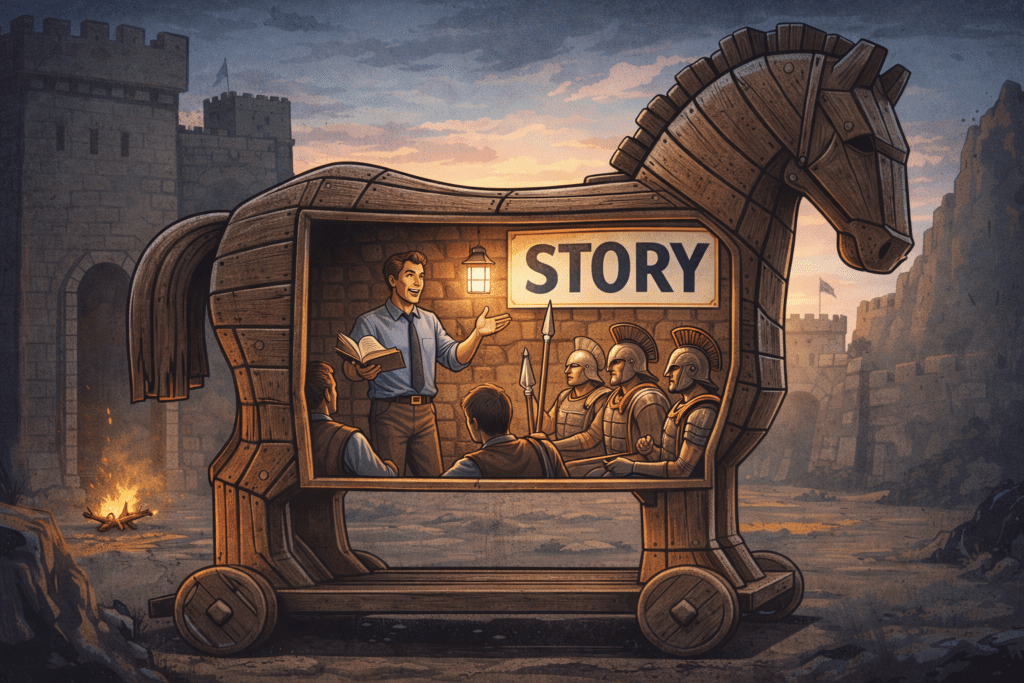
Think of the story as a Trojan horse. Inside the horse, you can pack all the facts, steps, warnings, details, and instruction you need. But the story gets through the gate first. It earns attention. It activates imagination. It helps the listener care.
Instead of just listing steps, tell a story about:
- Someone who skipped the steps and paid for it
- A moment when the process mattered
- A mistake that created unnecessary risk
- A real example that made the lesson memorable
Stories help people remember because they create movement. Information by itself can feel static. Story gives it consequence.
That is especially important when you are teaching something procedural. If the material feels lifeless, don’t just explain it harder. Wrap it in a narrative people can follow.
Analogies Help People See What You Mean
A close cousin to storytelling is analogy. Analogy takes an unfamiliar, technical, or dull concept and compares it to something people already understand. That gives the audience a shortcut.
You are helping them say, “Oh, now I get it.”
That matters because many boring topics are not boring because they are unimportant. They are boring because they are too abstract, too technical, or too disconnected from daily life. Analogy closes that gap.
You can compare:
- A complex process to a familiar routine
- A checklist to a preflight sequence
- A training sequence to building muscle memory
- A missed step to a small crack that leads to bigger failure
The point is not to be cute. The point is to be clear. When people can relate the material to something they already know, attention improves.
Visuals Can Wake Up a Dead Subject
Sometimes the fastest way to make a topic more interesting is to stop talking about it and start drawing it.
Whiteboarding, mapping, sketching, sequencing, and visual explanation can help people process information much more effectively than a long verbal explanation.
Why? Because visuals do a few things at once:
- They simplify complexity
- They show relationships
- They create pacing
- They give people something to follow
- They make the topic feel more alive
If your explanation is heavy, dense, or overly verbal, try putting it on a board.
Cut the Fat
Not every boring topic needs more creativity. Sometimes it needs less content.
A lot of material is boring because it is bloated. There is too much detail. Too much background. Too much repetition. Too much level-three and level-four minutiae before anyone understands the main point.
So trim it. Cut what does not need to be there. That does not mean oversimplifying critical material. It means respecting your audience enough to separate what is essential from what is merely available.
Ask These Questions
- What absolutely must be understood?
- What is useful but secondary?
- What is overly detailed for this audience?
- What can be saved for reference instead of spoken aloud?
When in doubt, simplify first. People do not need more information. They need better organized information.
Four Ways to Make a Boring Topic Interesting
Here is the short version:
- Don’t quit on it. If you give up on the material, your audience will too.
- Find what interests you. Even a small point of curiosity or pride can change the energy.
- Use stories, analogies, and visuals. These tools help information come alive.
- Trim the fat. Cut unnecessary detail that drags the message down.
Final Thought
Every communicator faces this challenge. You are handed a topic that feels dry, dense, or dead on arrival. You are tempted to disclaim it, apologize for it, or rush through it.
Don’t. Take it as a challenge. Accept the responsibility to generate interest rather than surrender to indifference.
In truth, most “boring” topics are not actually boring. They are simply presented without enough clarity, imagination, structure, or conviction.
That can change. And when it does, people listen differently.
How The BRIEF Lab Can Help
At The BRIEF Lab, we help professionals communicate clearly, briefly, and effectively, especially when the subject matter is complex, technical, or hard to explain.
Through our training, teams learn how to:
- Organize information logically
- Use stories and analogies with purpose
- Eliminate unnecessary detail
- Present with greater clarity and confidence
- Make important messages easier to understand and remember
If your team struggles to explain complicated or low-interest topics in a compelling way, we can help.
👉 Learn more or start a conversation here.
Joseph McCormack first shared these ideas in Episode 391 of the Just Saying Podcast