
The Hidden Cost of Too Much Context (aka Context Camping)
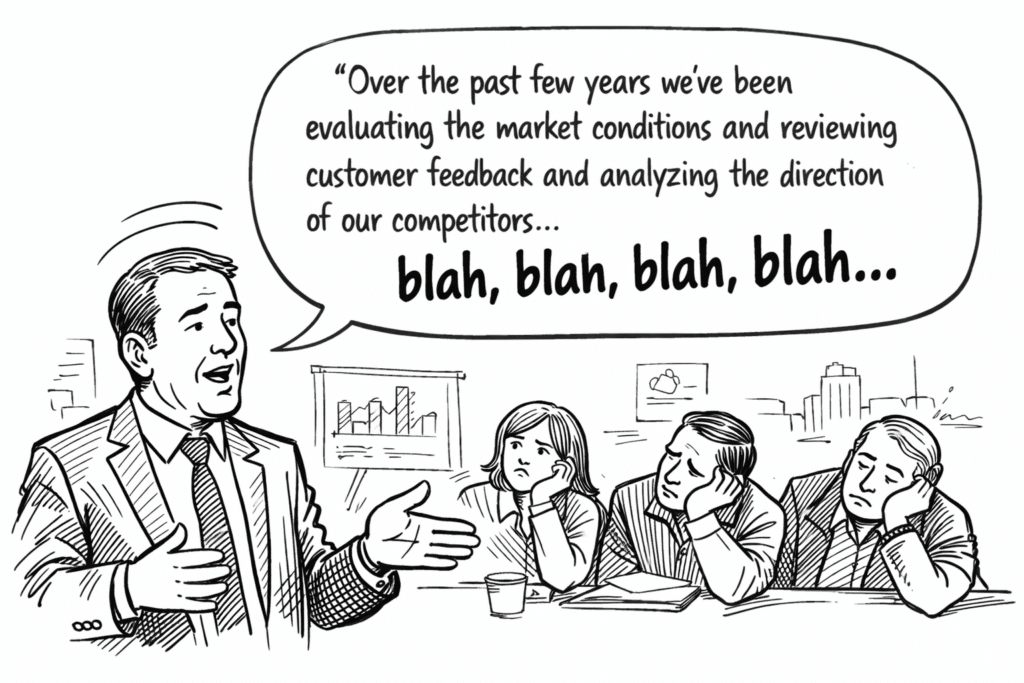
Professionals love context. We explain the history. We describe the situation. We walk through the background. Then we add more details—just to be safe.
And before long, something strange happens: The setup becomes the story.
I call this context camping—when a communicator spends so much time in background information that the audience never clearly hears the point.
In a noisy workplace where attention is scarce, this habit is dangerous. If your audience has to search for your message, you’ve already lost them.
Let’s talk about how it happens—and how to stop it.
What is Context Camping?
Context camping occurs when a communicator spends excessive time explaining background information before stating the main point.
Background is valuable. In fact, it’s one of the elements in our BRIEF Map, a visual tool we use at The BRIEF Lab.
A BRIEF Map organizes communication around five components:
-
B – Background: What led up to this?
-
R – Relevance: Why does this matter?
-
I – Information: What are the key details?
-
E – Ending: What outcome are we driving toward?
-
F – Follow-up: What happens next?
Background matters because it provides context. But it’s meant to support the story—not replace it.
When background dominates the conversation, the audience begins to assume the background is the point.
And that’s when clarity disappears.
Why Smart Professionals Fall Into This Trap
Context camping isn’t usually intentional. It happens because professionals are trying to be helpful.
They think:
-
“If I explain more, people will understand better.”
-
“Let me walk you through how we got here.”
-
“You probably need the full story.”
The result? The listener hears 10 minutes of setup before hearing the actual message.
Research on workplace communication consistently shows that attention drops quickly when listeners cannot identify the core message early.
In fact, cognitive science research on information processing suggests that people grasp and retain information more effectively when the central idea is introduced early and reinforced repeatedly.
The American Psychological Association has published extensive research on how cognitive load increases when people must infer the main idea themselves.
In other words: If you bury the point, people stop listening before they find it.
The Fix: Lead With the Headline
One of the core principles we teach at The BRIEF Lab is simple: Say the point early.
Don’t wait until the middle. Don’t hide it at the end.
Just say it.
For example:
❌ Context camping:
“Over the past few years we’ve been evaluating the market conditions and reviewing customer feedback and analyzing the direction of our competitors …”
The audience is already lost.
Now try this:
✅ Clear communication:
“We’re shifting our strategy from selling products to delivering services. Let me give you the background that led us to this decision.”
Now the listener knows exactly what’s coming.
Background becomes supporting information, not the story itself.
5 Ways to Avoid Context Camping
If you want to communicate clearly and concisely, use these simple practices.
1. Start With the Main Point
State your headline first.
Examples:
-
“The main point I want to make is…”
-
“Here’s the decision we’ve made…”
-
“The recommendation is…”
Clarity begins when the audience knows what you’re talking about.
2. Calibrate Background to Your Audience
Not every audience needs the same context.
Ask yourself:
-
What do they already know?
-
What don’t they know?
-
What do they actually need to understand the point?
If you’re unsure—ask them.
You might discover they already know the history.
3. Time Your Context
Background should be brief and intentional.
Try saying:
“I’ll give you two minutes of background before we get into the key point.”
Now the audience understands where they are in the story.
You’ve created a prologue, not a lecture.
4. Label the Sections of Your Message
Listeners can’t see your outline.
Help them.
Say things like:
-
“Let me give you some background.”
-
“Here’s why this matters.”
-
“Now let’s talk about the key information.”
When you label your structure, you manage attention.
5. Repeat the Headline
Even after providing context, come back to the point.
For example:
“So again, the main change we’re making is shifting from products to services.”
Repetition reinforces clarity.
Remember: The Point Is the Point
In every conversation, presentation, or email, you can always add more information.
But more information rarely improves clarity.
Instead, ask yourself one question:
What’s the headline?
If the audience can’t answer that easily, your message isn’t clear yet.
Don’t camp out in context. Say the point.
How The BRIEF Lab Can Help
At The BRIEF Lab, we help professionals think clearly and communicate concisely—especially in high-stakes environments where attention is limited.
Our communication training programs help teams:
-
Organize ideas using a BRIEF Map
-
Communicate decisions with bottom-line-up-front clarity
-
Structure conversations using the SPEAR verbal communication method
-
Reduce noise and improve focus with offerings from The Quiet Workplace
If your organization struggles with long-winded meetings, buried messages, or unclear communication, we can help.
👉 Learn more or start a conversation here.
Joseph McCormack first shared these ideas in Episode 389 of the Just Saying Podcast