
Be the Editor in Chief: Why AI Should Draft and You Should Edit
A few months ago, a client told me a story that still bothers me.
He had a board of directors meeting coming up. He created his presentation, then he put it into an AI tool for a final edit. He took the edits, walked into the room, and presented.
His board stopped him. “This doesn’t sound like you.”
They were right. It wasn’t him.
He looked at me like he’d been caught doing something he didn’t understand. “What did I do?”
I told him: “You got the order wrong.”
The Order Matters More Than The AI Tool
AI can write your first draft, but AI cannot be your editor in chief. That job is yours alone.
The moment you let an AI tool do the final pass, you hand over the one part of the process that carries your judgment, your nuance, and your voice.
The draft is raw material. The edit is where you show up.
Reverse that and you get what I call a “beige” message. It’s bland. It’s not distinctive. It’s not insightful. It reads like it could have come from anyone, which means it came from no one.
If AI is speaking for you, I don’t need you. Your value and identity erodes. And you won’t even notice it happening, because every step of it feels efficient.
TOWER: Five Steps, and Three of Them Are Yours
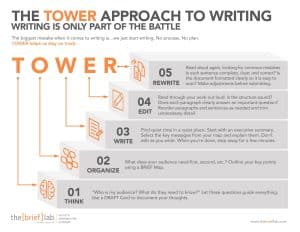
At The BRIEF Lab, we teach a writing method called TOWER:
- Think
- Organize (outline)
- Write
- Edit
- Rewrite
Look at where an AI tool actually belongs in that sequence. Step three. That’s it.
Steps one and two are you. Steps four and five are you. The AI tool gets one slot out of five.
Step 1: Think — Use a DRAFT Card
Before you write a word, work through five questions:
- Desired outcome — What effect do I want to have?
- Relationship — How do I relate to this person? How do they relate to me?
- Audience mindset — What are they thinking, feeling, and doing right now, before I engage, and what do I want them to think, feel, or do afterward?
- Format — Should this meeting be an email? Do I walk down the hall? Do I pick up the phone?
- Tone — Am I urgent? Stern? Encouraging? Excited?
No messaging yet. You’re thinking about the other person, your audience. AI doesn’t do this. It can’t. It doesn’t know your audience, your history with them, or what you’re actually trying to accomplish.
Step 2: Organize — Use a BRIEF Map
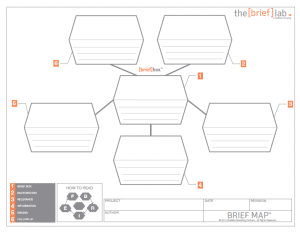
Then you outline:
- What’s my main message?
- What’s the background?
- Why should this matter to them?
- What key information do I need to convey?
- What’s the end state I’m driving toward?
- What’s the follow-up and the call to action?
Now you have a real understanding of your audience and your message. Now you can prompt an AI engine to produce a draft because you’re giving it direction instead of asking it to think for you.
Steps 4 and 5: Edit and Rewrite — Heavy Editing
This is where my client got it wrong, and it’s where most people get it wrong.
When AI produces a draft, it looks great. It reads clean, it sounds confident, and your instinct says that’s it, send it.
But it isn’t “it.” It’s a starting point that needs your input and judgment.
So here’s what I do, and what I’d ask you to do:
- Print it out. On paper. Off the screen.
- Buy a red pen. Redline it.
- Cut what isn’t yours. Rewrite the phrases you’d never say out loud.
- Keep going until it’s you. I did this on a flight recently. I kept telling myself, this isn’t me yet. I corrected, adjusted, re-prompted, and redlined until it was.
Then revise it until you can read it and say: This is good, and this is me.
If It Feels Easy, Something Is Wrong
Heavy editing is painful, but if the whole process feels like “click-click-send-submit” you are losing critical thinking. Your decision-making skills get dull.
You do it once and it’s fine. Then you do it twice and it’s a habit. Then it’s laziness, and you’ve stopped thinking altogether.
Sending an unedited AI draft is no different from sending your boss a bad first draft full of typos. The flaw here isn’t sloppiness, it’s absence. There’s no point of view, no judgment call about what actually matters and what should have been cut. There’s nothing in it that only you could have written.
And to a discriminating reader looking for insight, looking for you — the absence is obvious.
When you take on the role of editor in chief, your job gets momentarily harder. But your thinking and your voice survives.
Critical Thinking Comes From Quiet
I keep hearing from clients that their people all sound the same now. So they’re pumping the brakes and asking us what’s happening.
What’s happening is simple: Critical thinking is out the window, and critical thinking is where value is created.
Critical thinking comes from thinking alone, in quiet. If you skip the quiet and hand everything to an AI tool, you produce noise. And when everyone is hitting “send” on the same output, you get mounds and mounds of sameness and noise.
Where’s the distinction? Where’s the clarity? Where’s the brevity? The relevance? The tone? All of that must come from you.
I have files on my computer full of work I’ve done with AI. I remind myself every time: Slow down. Read it. What do you think? What does this mean? What would you change?
How The BRIEF Lab Can Help
If your team is producing more content and less meaning, we can help.
- BRIEF Writing Essentials teaches TOWER, the DRAFT card, and the BRIEF map — the method behind everything in this post.
- BRIEF Communication with AI is our newest course, created for what clients are experiencing now with “beige” messaging and lost voice.
- BriefBot is our applied learning platform in development — a digital brevity and clarity companion with our frameworks built in. You can register for the waitlist now.
Contact us to talk with our team about training your people to think first, edit hard, and sound like themselves.
Joseph McCormack first shared these ideas in the Just Saying podcast Ep. 400: My “humanity first” AI philosophy