
During the course of many years, I developed a methodology to organize and deliver corporate narratives. Earlier in my career, I used basic visual mind maps that helped clients outline and gain consensus on their core message. Eventually, I saw there was an opportunity for mind maps to help with more than messaging, which is how narrative maps were born.
While the narrative map began with General William Caldwell of the 82nd Airborne in the U.S. Army, we eventually evolved it to work for large multinationals and start-ups.
Today I’ll share with you what a narrative map looks like and how you can use it to deliver your message in a brief manner.
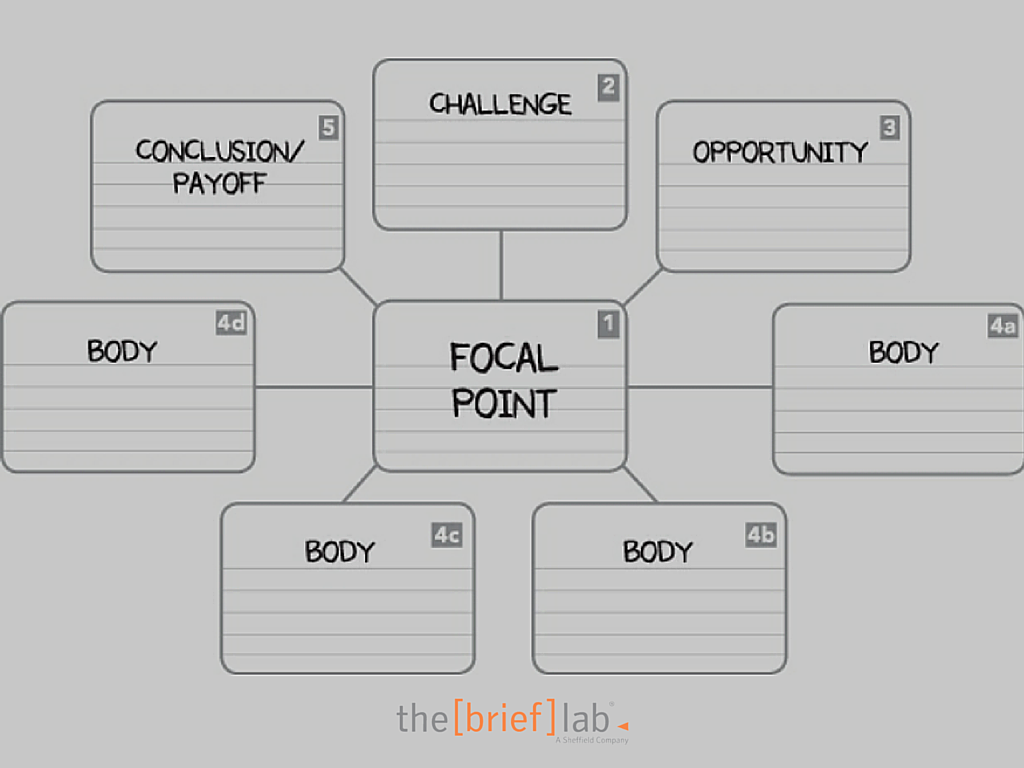
Narrative Map (De)constructed
Narrative maps consist of several important elements that make it easier to explain messages and give them clarity and context. They have a clockwise build; you begin with the center bubble and add bubbles around it clockwise.
There are five elements in a narrative map. We’ll take them one-by-one.
- Focal point (or center bubble). This is the central part of a narrative. It’s akin to a headline, which explains and isolates the point of the story. Is the focal point about innovation, change, competition, or something else.
- Setup or challenge. What challenge, conflict, or issue exists in the marketplace your organization is addressing? Why does this problem exist? Who contributes to it? This begins to isolate the major issue within the story.
- Opportunity. What is the implication or the opportunity for your organization? This is what some people call an unmet need or an aha moment. This is something you could use to effect change or to address and resolve an issue.
- Approach. How does your story unfold? What are the three or four characters or key elements? What is the how, where, and when?
- Payoff. All good stories have a conclusion or payoff. How do you resolve the setup from the beginning? Let’s say your story is about innovation, and there are four ways the company is going to create something new. How is that going to benefit a customer, an employee, the industry, or the community? Where does that story conclude? Who sees the benefits?
When you translate boring business speak into a narrative map, you apply a filter that makes it interesting because it synthesizes volumes of information into a visual outline that produces a logical, strategic, contextual, and relevant story. It is a credible story because your organization firmly believes the story is true and will influence people. And it is concise because it’s on one page.
Use your narrative map to tell your story to a client, share it with key audiences such as investors, partners, and employees, or build morale with employees.
You will have people nodding their heads in real understanding in less than five minutes.
How will you use a narrative map?